

It is important that you understand the cost components of living in aged care before you sign a resident and accommodation agreement. If you do not take the time to properly understand each component, there is a risk that you may end up financially over committed.
There are 2 main costs that you need to be aware of:
- The cost of accommodation; and
- The cost of care.
Aged care cost of Accommodation
The cost of aged care accommodation can vary significantly. The cost will typically depend on various factors such as: the location of the facility, the demand and availability of care in your area, and your lifestyle needs or preferences.
Once you have found a facility that best suits your needs, you will agree on the price of your accommodation with the provider. You will then have the choice to pay for accommodation in 3 ways:
- a refundable lump sum;
- a daily fee; or
- a combination of a lump sum and daily fee.
In some cases, you may be entitled to government assistance for the costs of your accommodation. However, government assistance should not be assumed. An Assets and Income Assessment undertaken with the Department of Human Services will confirm whether or not you are entitled to any government contribution to the cost of your accommodation and how much that contribution will be. This article does not discuss government contributions to the costs of accommodation.
Refundable Lump Sum
You may choose to pay for your accommodation with a Refundable Accommodation Deposit (‘RAD’). You will have 6 months from moving into the facility to pay the RAD, and you will be required to pay a Daily Accommodation Payment (‘DAP’) (discussed below) until the RAD is paid. The RAD is (subject to any agreed deductions) refundable when you leave the facility.
Once paid, your RAD will be guaranteed by the government. This means that if your aged care provider becomes insolvent, the government will step in and ensure that your RAD is returned to you along with any applicable interest accrued due to late payment.
Daily Fee
If you choose not to pay a RAD, you can instead pay for your accommodation via a DAP. DAPs are non-refundable daily payments. You will ordinarily pay your DAP in advance like a rental payment, but the facility cannot ask you to pay more than 1 month in advance.
You will also be required to pay interest. The interest component of your DAP is built into the calculation of the DAP as at the rates of the maximum permissible interest rate (‘MPIR’) as at the date you enter into the facility. Your DAP calculated on the following formula:
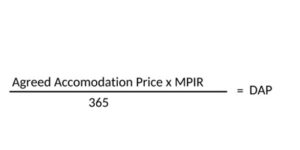
For example, if your agreed cost of accommodation is $400,000, your DAP would be calculated as follows:
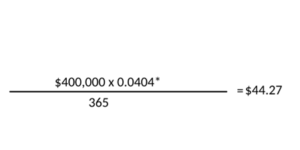
*this is the MPIR at the date of publishing, being 20 September 2021.
The current applicable rate of the MPIR is accessible here.
Combination of a Refundable Lump Sum and Daily Fee
You may instead choose to pay with a combination of a RAD and a DAP. For example, if you have an agreed accommodation price of $400,000, and you wish to pay $200,000 as a RAD, your DAP will be calculated as follows:
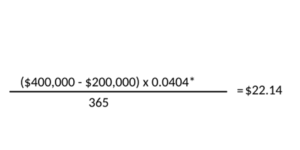
*this is the MPIR at the date of publishing, being 20 September 2021.
You may draw down on your RAD to pay your DAP. However, your resident and accommodation agreement will likely have a clause for periodic reconciliation of your accommodation fees. Your provider can require you to maintain your accommodation payments (i.e. ensure that they are not left any worse off by you drawing on your RAD). You can choose to maintain your accommodation payments by: increasing your DAP (see formula above) to account for the change in RAD; top up your RAD to the agreed amount; or do a combination of the two.
Which of these payments options is right for you will depend on your circumstances. We recommend that you obtain financial advice before deciding which payment option best suits you.
The costs of Care
You are required to pay for the cost of care in addition to the accommodation costs. This is for care services provided by the facility, such as: laundry, meals, cleaning, and maintaining the facilities.
The cost of your care will be subsidised by the government. The degree of that subsidy from the government will depend on your financial position. You will therefore need to have an Assets and Income Assessment undertaken with the Department of Human Services or Department of Veterans Affairs to determine your financial position.
We recommend that you have your Assets and Income Assessment completed before entering into a resident and accommodation agreement. If that is not feasible, we recommend that you in the very least complete the online fee estimator and consider seeking financial advice.
There are 4 components to your care costs:
-
- Basic Daily Fee;
- Means-Tested Care Fee;
- Fees for additional services; and
- Extra service
Basic Daily Fee
The Basic Daily Fee is paid by all residents. It is calculated to be 85% of the single person rate of the aged pension. As of 21 September 2021, the maximum basic daily fee is $53.56 per day. The rate will vary with the amount of the aged pension. It is usually updated twice per year. The current applicable rate is published here.
Means-Tested Care Fee
Depending on your means, you may be required to make further contributions to the cost of your care (i.e. the government may subsidise less of your care depending on the result of its means-testing). If you are required to pay the means-tested care fee, you will be advised of the amount by Services Australia. The amount is likely to vary during the course of your care to reflect changes in your means.
As at the publish date of this article, the maximum daily means-tested amount is $259.26 per day. This amount is indexed and will change from time to time.
There are also annual and lifetime maximums of the means-tested care fee that can be charged. As at the publish date of this article, the amounts are:
- $28,792.36 per annum; or
- $69,101.75 in a lifetime.
Additional Service Fees
Your chosen facility may offer certain services above the statutory minimum, such as pay-tv, entertainment, or alcohol. The cost of these items are not subsidised by the government and are in additionto the basic daily fee and any means-tested care fee.
Depending on the facility and their particular offerings, these additional services may be offered as standalone extras or as part of a package. You should take extra care to ensure that you do not sign up for unnecessary additional services that you will not utilise.
Extra service fees
Some facilities may have extra service status. This means that they can provide extra services for a fee, such as better meals. These extra services are not subsidised by the government and are in additionto all other fees.
You should take extra care to ensure that the facility you have chosen provides any extra services that you require and that the fees are acceptable to you.
We highly recommend that do the followingbefore signing an aged care resident and accommodation agreement:
- Obtain legal advice as to the terms of your resident and accommodation agreement. Make sure that you understand your rights and obligations prescribed in the agreement.
- Obtain an Assets and Income test from the Department of Human Services. This will help you better understand the real costs of your care.
- Obtain financial advice to help you chose the payment option which best suits your means and lifestyle. For example, a financial advisor may be able to help you maximise your access to the aged pension.
- Consider potential future changes to your fees. It is best if you can avoid having to move facilities later due to affordability issues.
Have a question about Aged Care Cost?
Moving into aged care is a big step both financially and emotionally. It is important that you take that step confidentially. If you need assistance or legal advice regarding aged care residential and accommodation agreement, Vocare Law can well assist. Contact our office on 1300-VOC-LAW / 1300-862-529 or email: enquiry@vocarelaw.com.au
This article was written by Paul Neville.
**The information contained herein does not, and is not intended to, constitute legal advice and is for general informational purposes only.

